
Ancestral Nutrition 101 & Beef Kidney Supplement Benefits
For most of human history, nothing went to waste. When ancient hunters brought down an animal, they didn’t just eat the muscle meat and walk


Most people assume a supplement is a supplement — that whatever nutrients are listed on the label are the nutrients you’re actually getting. With organ supplements, that assumption falls apart fast. How an organ is processed after harvest determines how much of its original nutrition survives long enough to reach your bloodstream. Heat, oxygen exposure, and processing shortcuts can strip out the exact nutrients people take organ supplements for in the first place. Freeze-drying is the answer the highest-quality organ supplement brands have converged on, and understanding why it works is the difference between buying a supplement that delivers and one that’s mostly filler.
Freeze-dried organ supplements start as raw organ tissue — liver, heart, kidney, and similar cuts — that’s flash frozen almost immediately after harvest to lock in freshness before any nutrient breakdown can begin. From there, the frozen organ goes into a vacuum chamber, where moisture is removed through a process called sublimation: ice turns directly into vapor without ever passing through a liquid state, and critically, without the tissue ever being exposed to heat. What’s left behind is a lightweight, shelf-stable powder that retains the vitamins, minerals, and enzymes of the original organ almost fully intact. That powder gets milled and encapsulated, giving you a capsule that’s chemically much closer to raw organ meat than to a conventional processed supplement.
Not all “dried” organ supplements are made the same way, and the method used has a direct effect on nutrient retention.
| Method | Process | Heat Involved | Nutrient Retention |
| Freeze-dried | Flash frozen, moisture removed via vacuum sublimation | None | Highest — closest to raw organ |
| Desiccated | Low-temperature oven drying | Low to moderate | Moderate — some heat-sensitive nutrient loss |
| Air-dried | Dried using ambient or warm air over time | Moderate to high, plus long oxygen exposure | Lowest — significant degradation of heat- and oxygen-sensitive nutrients |
Freeze-Dried
No heat is involved at any stage, which preserves fragile compounds like B12 and certain enzymes that break down under even mild warming.
Desiccated
This is the traditional method used by many organ supplement brands, and while it’s better than nothing, the low, sustained heat used to dry the organ still degrades a portion of its heat-sensitive nutrient content over time.
Air-Dried
Air-drying takes the longest and exposes the organ to both warmth and prolonged oxygen contact, which is the combination most likely to degrade nutrient potency before the product even reaches encapsulation.
Of the three, freeze-drying is the only method that avoids heat exposure entirely, which is why it consistently preserves the widest range of heat-sensitive nutrients.
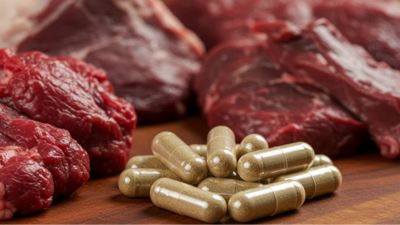
The nutrients organ meat is prized for are also, unfortunately, some of the most fragile under heat — which is exactly why processing method matters so much. Vitamin A, true vitamin B12, and folate all degrade with heat exposure, and freeze-drying is what allows a supplement to retain levels close to what’s found in raw organ tissue. CoQ10, a compound central to cellular energy production, is similarly heat-sensitive and benefits from a no-heat process. Heme iron, the highly absorbable form of iron found in organ meats, stays chemically stable through freeze-drying rather than being altered by cooking. Freeze-drying also preserves naturally occurring enzymes and peptides that are otherwise destroyed by cooking temperatures. This is part of why Grazin Health uses a non-defatted process — leaving the natural fat content intact rather than stripping it out — since several of these nutrients, including vitamin A, are fat-soluble and are better preserved and absorbed when the organ’s natural fat isn’t removed.

Liver is the most nutrient-dense organ overall, delivering vitamin A, B12, CoQ10, and heme iron in concentrated form. Heart is particularly rich in CoQ10 and is a go-to for supporting cardiovascular energy and endurance. Kidney supplies selenium and B vitamins and is traditionally associated with detox support. Spleen is valued for its iron content and is often included for immune and blood-building support. Pancreas contains natural digestive enzymes that some people use to support digestion. Brain is a concentrated source of phospholipids and omega-3 fatty acids tied to cognitive function. Each organ brings a different nutrient emphasis, which is why some people prefer a single-organ product like liver, while others opt for a full organ complex — combining several organs into one formula for broader coverage, an option Grazin Health offers alongside its standalone organ capsules.
Who Should Take Freeze-Dried Organ Supplements?
Freeze-dried organ supplements are a natural fit for people following paleo, keto, or carnivore diets, since organ meat aligns with those eating patterns but isn’t always practical to prepare at home. They’re also useful for anyone with known nutrient gaps, particularly around iron, B12, or vitamin A. Athletes often use them to support energy production and recovery, while women with higher iron needs — especially during menstruation or pregnancy planning — may turn to organ capsules for their highly absorbable heme iron. And for the large number of people who simply can’t stomach eating liver or heart directly, freeze-dried capsules offer a practical way to get the nutrition without the plate.
What to Look For When Buying Freeze-Dried Organ Supplements
Not every product labeled “freeze-dried organ supplement” holds up under scrutiny, so a few sourcing and processing details are worth checking before you buy. Grass-fed, pasture-raised sourcing matters, since the animal’s diet directly affects the nutrient density of its organs — Grazin Health sources exclusively from pasture-raised cattle. A clean ingredient list matters too: look for products without fillers, flow agents, or unnecessary additives, since organ powder alone should be enough to fill a capsule. Non-defatted processing is another marker of quality, preserving the natural fat-soluble vitamins rather than stripping them for a longer shelf life. Finally, independent lab testing for potency, heavy metals, and contaminants is what separates a verified product from one relying on label claims alone — every batch of Grazin Health’s organ supplements is third-party tested for both potency and absorption, and shipped in biodegradable packaging as part of the brand’s broader sourcing standards.

Are freeze-dried organ supplements as good as eating fresh organs?
They’re close. Freeze-drying preserves the vast majority of an organ’s original nutrient content because no heat is involved in processing, so while nothing is chemically identical to fresh tissue, freeze-dried organ powder retains far more of its nutrition than cooked or otherwise dried alternatives.
Do freeze-dried supplements lose nutrients over time?
Freeze-dried products are shelf-stable and degrade very slowly when stored properly in a cool, dry place, since removing moisture is what limits the oxidation and microbial activity that typically cause nutrient loss over time.
What’s the difference between freeze-dried and desiccated liver?
Freeze-dried liver is processed with no heat at any stage, using vacuum sublimation to remove moisture, while desiccated liver is dried using low, sustained heat — a method that preserves nutrients reasonably well but not as completely as freeze-drying.
Are freeze-dried organ supplements safe?
Yes, for most people, particularly when sourced from grass-fed, pasture-raised animals and third-party tested for contaminants. As with any supplement, anyone who is pregnant, nursing, or managing a medical condition should check with a healthcare provider before starting one.
How should freeze-dried organ supplements be stored?
They should be kept in a cool, dry place out of direct sunlight, ideally in their original sealed packaging, to maintain potency for as long as possible.
Curious how process quality shows up in the capsule? Explore Grazin Health’s Organ Complex and single-organ supplements — freeze-dried, non-defatted, and third-party tested from pasture to powder.
Statements regarding dietary supplements have not been evaluated by the FDA and are not intended to diagnose, treat, cure, or prevent any disease or health condition.
For most of human history, nothing went to waste. When ancient hunters brought down an animal, they didn’t just eat the muscle meat and walk

Nutrient supplements for mood support aren’t a fringe idea; supplements to help improve mood have become an increasingly evidence-backed piece of a broader approach to mental

Beef Organ Supplements for Women: Which Organs Matter Most for Women’s Health? If you’re new to nose-to-tail nutrition, one question comes up almost immediately: with

Are Beef Organ Supplements Good for You? Here’s What the Research and Ancestral Nutrition Say It’s a fair thing to wonder. Organ meat isn’t exactly
